
Creative Destruction: The Land Bank finds creative uses for salvaged materials from distressed buildings
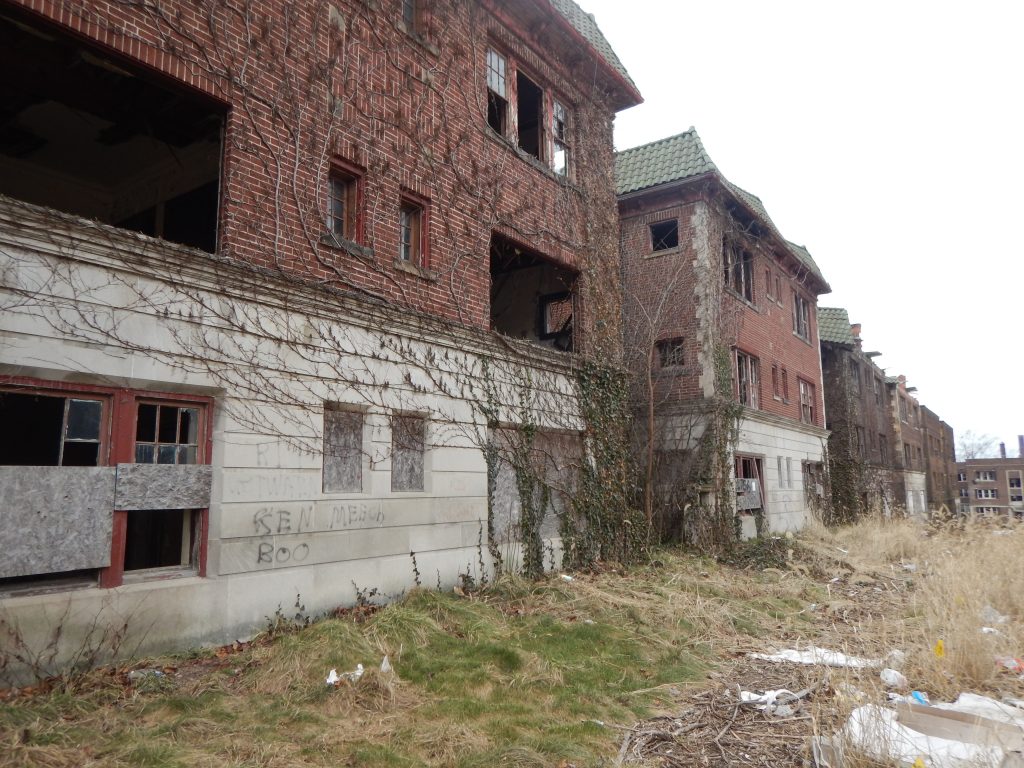
Land Bank-salvaged sandstone from East Cleveland, now in Circle East District, is an environmentally responsible, cost effective and nostalgic link to history.
The towering apartment buildings that covered entire blocks in East Cleveland are gone. But because of the work of Cuyahoga Land Bank Commercial Demolition Officer, Jim Maher, more than 100 tons of Ohio-mined sandstone from multiple East Side demolitions have found new purpose in the Circle East District.
About 50 pallets worth of Northeast Ohio’s Berea sandstone has been salvaged over the last few years from the Land Bank’s demolition of East Cleveland’s Burnette apartments on Euclid Avenue and from a half-dozen separate apartment buildings running the length of Chapman Avenue of Euclid Avenue.
“The Chapman buildings had this incredible sandstone veneer that spanned the entire block,” Maher said. “Each building had a slightly different design but together it created a cohesive wall of sandstone going down the street.”
When dust had settled, so to speak, the Land Bank, Maher said, was able to salvage about 30 percent of the usable sandstone from Chapman Avenue. That number might not sound like much, but it has provided material for everything from retaining walls to seating in Circle East’s greenway, and much more is in storage.
The salvaged pieces came in different shapes and sizes, Maher explains, some pieces were perfect for the Circle East District’s Greenway, a green neighborhood pathway parallel to Euclid Avenue located just Northwest of Daffodil Hill at Lake View Cemetery. The pathway, created from vacant Land Bank lots cuts through multiple side streets – including Penrose Avenue and Brightwood Street – and uses the recycled sandstone for seating and marking the edges of the path interspersed between gazebos, bike racks and picnic tables.
Other larger foundation pieces of sandstone were used in the $3.5 million renovation of Mickey’s, an art-deco-inspired building originally-constructed in 1949 as a Buick dealership.
Large sections of the stone now make up a retaining wall along the edge of the parking lot near the corner of Euclid Avenue and Lakeview Road – part of the commercial renewal of the Circle East District.
“Some of the material was even used to build a small, Greek-like amphitheater at one end of the Circle East Greenway. It is not a large amphitheater, but it is unique because and a great and unique thing we could add to the greenway and the community,” Maher said.
Reusing the sandstone in the Circle East District ticks off a few of the project’s overall priorities. The repurposed material is a physical manifestation of the historic East Cleveland neighborhood while also representing a hope of real, sustainable renewal. And the environmental and cost have a minimal impact on the project overall.
The massive haul of sandstone isn’t the only historic treasure the Land Bank has been able to salvage from the properties and buildings demolished over the years.
Maher helped oversee a plan between Slavic Village Development’s Krystal Sierra and Rebuilders Exchange (RBX) – a local construction debris recycling and reclaim business – to save a piece of local history.
Sierra worked with RBX to mobilize a crew to carefully move a massive two-story, neon-sign from the Brown Brother’s furniture store on Broadway Avenue in Slavic Village, before the hollowed-out building was demolished.
The building was abandoned for about two decades, but the sign was a reminder of better times for the once busy commercial corridor. “We were able to save that sign and find someone who could safely remove and store it,” Maher said. “The keys to any salvage are that it has be safe and there has to be a place to store it.”
Sandstone and signs are not the only things worth saving, Maher explains. This past winter, he also worked to rescue yet another nostalgic symbol of Cleveland’s history during the clean-up and remediation of the former Euclid Beach Mobile Home Park.
Before the more than 28-acre lakefront property became a small mobile home park, for 74 years it was known by families in and around Ohio as the Euclid Beach Amusement Park, which at its peak had more than two million visitors a year.
“In the middle of the mobile home park was this concrete ticket booth from the Euclid Beach Amusement Park days,” Maher said. “We told the Metroparks that it was there and still standing, and they were quick to send out a crew to get it. It is in storage now but eventually, it’s going to have a place here once the new park is completed.”
Unfortunately, not every salvage ends with a successful recycle or reuse story. Maher remembers another attempt to rescue a large neon sign, which resulted in a big crash. There was another time that after he gave permission to a neighbor to pull siding off a house scheduled for demo, police were called and that person ended up spending the weekend in jail.
There is also a lot of potential liability when salvaging materials in distressed buildings, Maher cautions.
“We took down a building once and gave away the salvage rights to a third party that does wood salvaging. It was like a four-story apartment building on St. Claire, and during the salvage all these structural pieces were removed, which made it very unstable. It was a scary tear down,” Maher pointed out.
